
Sunday, December 29, 2013
Lois Lowry's The Giver
The Giver by Lois Lowry is a book that has made an impression on me. The Giver is a a story of a boy named Jonas who lives in a perfect city. In this city all forms of emotion, such as happiness, fear, pain, love and sadness, are removed. The emotions are all stored inside one person called the "Receiver of Memory" who holds memories of the past. The memories are kept away and brought out when decisions are needed to be made to prevent making similar mistakes. In this world there is no color and they kill off defective people. The book made an impression on me because it shows that you cannot have a perfect world. Our flaws are what help make us who we are.


Friday, December 13, 2013
RoboFrog, My 3 lb. Battlebot
This year I made my second generation battlebot, a 3 lb. combat robot called RoboFrog.
 Its weapon is an aluminum spinning drum with spikes on it. I competed at a 3 lb. battlebot competition in Miami at Starbot, Inc on December 7, 2013. I won three out of the five matches I competed in.

During one of the matches, another drum robot ripped my drum off and I had 10 minutes to completely rebuild it.
 I was able to rebuild it and compete again. I took 2nd place in the competition.

Thursday, December 12, 2013
Robotics Competitions - Mini Robots Battle
My essay on Battlebots was selected and published by The Bunk Room magazine. Robotics Competitions - Mini Robots Battle
Tuesday, December 10, 2013
105 miles on the Appalachian Trail
In the summer of 2012, I hiked 105 miles on the Appalachian Trail with Eagle’s Nest Foundation.When I decided that I was going to hike the Appalachian Trail I trained for 9 months by going to the gym, lost 30 pounds and got into great shape. Now I am training for a triathlon with my dad. We run, bike and swim in the ocean every weekend. When I set a goal, I work towards it.
I carried a 50 pound pack containing food, clothing and tools needed to survive. I love the simple living on the trail, from cooking delicious meals over a portable alcohol stove to sleeping under the stars in a sleeping bag. The surrounding area was mostly a luscious green forest. The experience was challenging but very gratifying and rewarding.

I carried a 50 pound pack containing food, clothing and tools needed to survive. I love the simple living on the trail, from cooking delicious meals over a portable alcohol stove to sleeping under the stars in a sleeping bag. The surrounding area was mostly a luscious green forest. The experience was challenging but very gratifying and rewarding.
Thursday, November 21, 2013
3D print of my leg


Then I carved out the shin portion of the leg with a knife. I broke the tubular fibula print in the area where I broke my own bones and glued them in place. Then I painted it.


Friday, September 13, 2013
I broke my leg! Part two
After the surgery was done, the doctors put a permanent splint on my leg with a water cooling system that weighed 30 pounds.
 I was sent home and told to come back in a week. I lay on the couch at my grandmother's house for a full week without getting up except for going to the bathroom. I had to use a commode.
 After a week I went back to the hospital and they took off the impermanent splint, put on a removable boot and said that I could now walk on crutches. The first time I stood upright, without weight-bearing, the blood rushed down to my leg. It hurt a lot and I was instructed that I had to do this every hour during the day to keep the blood flowing in my leg so that it would heal faster.
.JPG)
Friday, September 6, 2013
I broke my leg!
This last summer I broke my right leg while I was visiting my grandmother on Whidbey Island, an island near Seattle, Washington. A few steps past the backyard of my grandmother’s house is the beach. One day I went exploring on the beach with my friend Michael. Looking for driftwood, we came across a very intriguing clearing. There was a clay wall hidden behind blackberry bush vines. I decided to go in between the wall and the blackberry bushes. I still can't recall why, but I decided to climb up the clay cliff, not knowing the possible consequences. When I was about 15 feet above the ground I realized that it would be very difficult and dangerous to go back down, so I decided to go higher to find an easier way down. Once I was 25 to 30 feet up, I realized the only way down was a very steep slope. My plan was to grab onto trees on the way down and work my way to the bottom little by little. As I was getting into position for the first step down, the root that I was holding broke free of the clay wall and I plummeted down! As I was sliding I realized that something bad was going to happen, but I only thought it would be a sprained ankle and not much more. By the time my feet made impact I was going roughly 15 miles an hour. When I landed, I felt a small pain in my leg but I thought it was just the impact of the landing and in my mind I thought that I had made it. Michael, who was watching me climb and saw me slide down, pointed at my right shin. I looked down to find what appeared to be a second knee a few inches underneath my real knee. All of a sudden, I felt a very sharp pain jolt through my body and at that very moment I realized that I had severely broken my leg. I quickly sat down and positioned my leg up right and was in agonizing pain. My friend ran back to my grandmother’s house to get help as I took cold rocks and placed them near my break to prevent major swelling and because it felt good. I was about a quarter-mile down the beach and it took around 45 minutes for the paramedics/firefighters/police to come and rescue me. They wrapped my leg in a splint and put me on a stretcher. Then they put me on a one wheeled structure to carry me off the beach. I was rushed up to the Coupeville hospital to get x-rays. As it turned out I had severely broken both bones in my leg. My tibia and fibula were completely cracked in half, as shown on the x-rays below. The doctor said that this was a major injury and I needed surgery. I was then taken by ambulance off the island to Seattle Children’s Hospital, where I had surgery the next day. Titanium rods were inserted into the tibia of my right leg.


Friday, May 3, 2013
Why 3D Printers are Useful
Who wouldn't want a machine that can make almost anything? 3D printing is useful for manufacturing because it is an additive process. It lets you make personal parts and gives you the ability to build quick prototypes.
3D printers are practical because 3D printing is an additive process. In other words, instead of starting with a block of material and shaping it until you attain your part, with 3D printing, the machine builds your part one layer at a time from the bottom up.
For the same price, and with the same machine, you can make personal parts. For instance, you can have a toy with your name on it and I can have a toy with my name on it for the same material cost.
Another useful application of 3D printers is the ability to make quick working prototypes. You can think of a product, design it on a computer with a CAD program, print and hold your idea in your hands.
3D printers are terrific for people who like to make things. The ability to hold your thoughts in your hands is going to change the manufacturing industry.

Friday, February 22, 2013
The City of Ember Book Summary

The City of
Ember, a science fiction novel by Jeanne DuPrau, takes place in an underground city that was made to keep the human race alive
after the war/plague. The underground city, Ember, is falling apart and running out supplies such as food, clothes, soap and school items. It is a dark, damp, mold filled, dying city. The people in the city have become less aware of what humans used to know and do not know how to fix broken things and only know how to replace them. This is why, when supplies start to run out, they are forced to leave the city because they do not know how to survive. In the book, the main character, a 12 year old girl named
Lina, finds a piece of paper with instructions. The instructions explain how to leave Ember once Earth becomes safe to live on again. While on her journey, Lina gets help from
a boy named Doon. In the end, the people of Ember get to the world
above, but have no idea how to survive. The book seems to be addressing that today we do not make our own things anymore and we are materialistic consumers.

Monday, February 18, 2013
Railroad Track Anvil


Thursday, November 8, 2012
The Stainless Steel Container: A Description

The color is
brushed metallic silver. It mirrors the light and makes a frosty gray line. Out
in the sunlight, it is hard to look at because the shiny metal reflects the sun.
There are very fine streaks going horizontally around the cylinder. All the
edges are rounded and smoothed. It does not have any sort of seam. It
looks as if it is one solid piece of stainless steel. I
can wrap both hands around the cylinder with my fingertips touching. The top of the container is open, and the bottom is closed off. There are over 300 holes smaller than my
pinky tip. From eye level, I see a rectangular cylinder with rectangles made of
dots. The shape reminds me of a big cup. It can hold other objects such as
pencils, silverware and other knick knacks. I would like to use it as a pencil
holder in my room. It feels like slick
glass but grips to my fingers with a bit of traction. The holes feel like a
cheese grater. The texture reminds me of my pocket knife. They are both made
from stainless steel and have the same brushed finish. On my forearm, the
cylinder feels like cold glass, almost like ice. Against my cheek, it feels
cold at the beginning, then the metal heats up rapidly until it is the same
temperature as my cheek, so it feels neutral. When I smell it, I
imagine a surgeon’s rooms with everything made of sterile stainless steel. The
smell is sharp and makes my nose tingle. It makes me feel comforted because the
smell of metal reminds me of working at
StarBot where I do robotics and engineering. The object alone
does not have any sound, but if I flick it with my fingernail quickly, it will
make a high-pitched ringing resonating sound. When I drop it on a tile floor,
it makes a clanging sound and it reminds me of when you pull pots and pans out
of a cupboard.
Tuesday, October 16, 2012
Writing Workshop: The Super Sandwich
The Super Sandwich

At twelve noon on a sunny Friday, I was in my kitchen. I was very hungry and wanted lunch, so I decided to make a sandwich. I found two pieces of soft wheat bread and put them in the toaster. Ding! They were done. Rapidly, I took them out and put them on the counter. I put shiny olive oil, Swiss cheese slices and salty ham on the crispy bread. But I wanted more, so on went crunchy lettuce and juicy tomato. I fried up some bacon and added three sizzling strips. Hungrily, I wolfed down a big bite. But I felt like it was missing something. So I ran quickly to the cupboard and pulled out a green, squishy avocado and spicy red hot sauce. I added a thick layer of avocado and shook the hot sauce over the whole stack. As I was about to take a second bite from my now pretty large sandwich, I thought to myself, “I am so hungry I could eat way more than this.” So I decided to go all out and put anything I could find from the kitchen on it. I added a cooked hamburger patty, black olives, wavy potato chips, slices of onion, finely diced garlic, thinly sliced pineapple, green apple, red apple, strawberry yogurt, hummus and a fried egg. Now my sandwich was two feet high. I lifted it up, but I could not fit it into my salivating mouth. It started to fall apart, slipped from my hands and fell all over the floor. All the ingredients coated the floor at my feet. I looked at the pile of food and thought it was disgusting. I didn’t want it anymore. My dog came into the kitchen and started to lick it up. As she gobbled up the super sandwich, I was relieved that I did not have to clean it up. I went to the cupboard and got a bowl of cereal. My lunch was delicious.
Thursday, September 27, 2012
The 3-D Printer: The Dream Machine
Have you ever wanted a machine that could make almost anything? A machine like this is now becoming easier to own. Desktop 3-D printers are storming the market. A 3-D printer is a machine that can make objects out of plastic, anything from an iphone case with your initials to a fully functional whistle. Essentially, it can make anything you can imagine. 3-D printers have been around for over 30 years but have been primarily industrial and experimental rather than a personal product. Recently, companies have been making 3-D printers that are a lot more affordable. Until recently, they still cost more than $1,500. There are many individuals getting into the 3-D business and trying to design a machine that is both affordable and reliable. A new company has recently emerged with a printer called the Solidoodle that costs $500.
 Imagine a machine that is a foot wide, a foot tall and a foot long made of stainless steel. It is like a very precise hot glue gun. It takes plastic filament and heats it up to its melting point, from 210°C - 250°C. A stepper motor, a very precise motor that measures in steps, pushes out the melted plastic filament in a very thin strand (0.3 mm). The strand is approximately the thickness of a strand of human hair. There are different types of plastic you can use. One of the most common ones is ABS (acrylonitrile butadiene styrene). ABS is the same plastic used to make Legos and most toys. You can buy the plastic in 1 kilogram (2.2 lbs.) spools of filament. The current price for a spool is around $45.00. According to the companies, these spools should last you awhile. You can buy different colored spools. Right now you can only make monochrome objects. So if you put red plastic in the 3-D printer, the object will be all red and if you put green, the object will be all green.
The thin strands of plastic are put on an aluminum plate that is heated so the plastic will stick to it. The 3-D printer then prints layer after layer of your object until your object is finished. How does the robot know what to print? To make something on a 3-D printer, you have to first design it by using 3-D modeling software such as Google SketchUp, Maya or any other modeling software that can save in STL (STereoLithography). You can also go to a website called Thingiverse.com that has thousands of designs that you can download and print.
I think that in the next 10-15 years, most people who already own a computer and an ink jet printer will also own a 3-D printer. Picture wanting to have something and being able to hold it in a matter of hours. 3-D printers are revolutionizing manufacturing.
Sunday, September 16, 2012
A Book Summary: The Invention of Hugo Cabret by Brian Selznick

The story takes place in a train station in Paris.


Hugo is twelve-year-old boy who lives inside the train station. Hugo's father, a watch-maker, finds an automaton in a museum, and in his free time, he tries to fix it. An automaton is a complex, gear-driven machine that does a task.Unfortunately, the museum burns down and the father dies. Hugo goes to the burned museum, finds the automaton and tries to fix it with found and stolen materials.
Isabelle is a girl who helps Hugo go on his adventures.

Papa Georges is an older man who works in a toy booth in the train station and is Isabelle's godfather.

The story ends with Hugo living with Papa Georges and Isabelle. he goes to school and makes his own automaton. The Invention of Hugo Cabret is over 500 pages but more than half of them are very detailed and descriptive pencil drawings.
Friday, August 24, 2012
Summer Blacksmithing: How I made a Forge on Whidbey Island
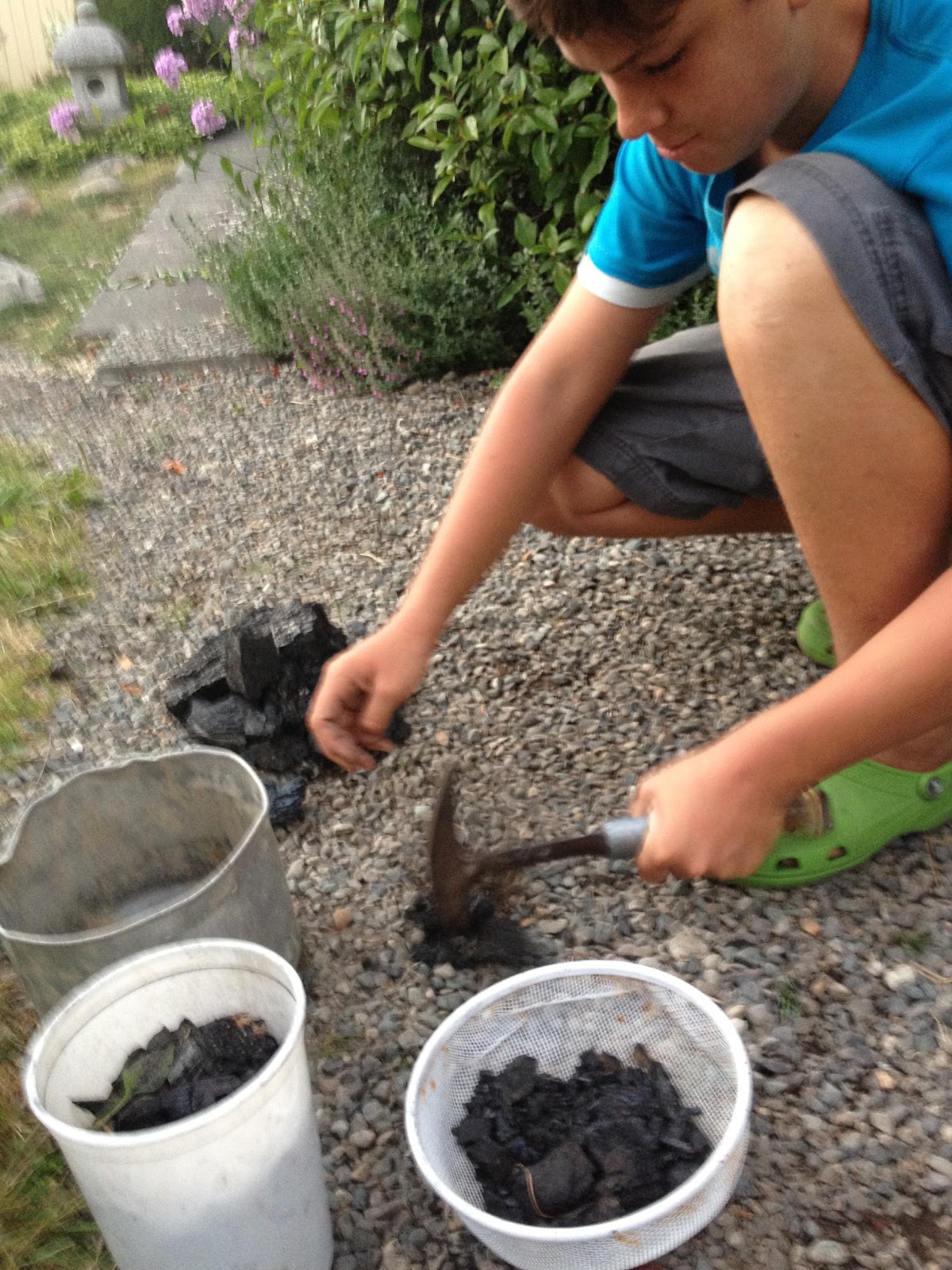
This summer on Whidbey Island I made a blacksmith forge. It reached over 2000°F. I made the forge by going to the thrift store and buying a pot, a pan and a hairdryer. At the hardware store, I got long nails, a glue called, "J.B. Weld" and a small metal pipe. I got the J.B. Weld glue because it can get to over 500°F. It was the glue which was the most tolerant to heat that I could find. I then went on the beach that is located in our backyard and found some damp drift wood, squishy, cold clay and found a big block of sparkly coal. Then, I made the forge by first drilling holes in the pan. After, I glued the pan on top of the pot with J.B. Weld. I put a hole in the pot and glued the pipe in it. I attached the hairdryer to the pipe with duct tape.
I took a hammer and broke the coal down into little pieces.

 Then, I put the little pieces of coal in the top of the forge and lit it. I then turned on the hairdryer and the coals got really hot. I was very excited. The first time I fired up the forge I just flattened a piece of steel. The anvil I used was a piece of railroad track that was given to me by a friend. The next day I fired up the forge, I made a knife from a nail which I had found on the beach.



.JPG)

.JPG)
.JPG)
.JPG)
.JPG)
Monday, April 30, 2012
Titanium
This year I decided to make a 3 lb. Battle Bot. I manufactured it at StarBot, a facility where children can use complex industrial machinery. I first designed it on paper and figured out what kinds of materials I was going to use. I made a wooden prototype. Over the next month or two I finished my first 3 lb robot, which I call Titanium.
I fought with it at the 2012 STEM TECH Olympiad.
This is my 3 lb. Battle Bot. It's weapon is a red, titanium, spinning blade on the front. It's armor is painted black.
I fought with it at the 2012 STEM TECH Olympiad.
This is my 3 lb. Battle Bot. It's weapon is a red, titanium, spinning blade on the front. It's armor is painted black.

My brother, Miguel, and I made a logo for the robot.
Our Logo

Our logo is an "i" inside of a "T", representing the periodic table symbol for Titanium. XX11 represents the atom
count (22).
Here is the logo sprayed on the robot.

We also made stencils to lay on top of T-shirts. We sprayed painted them to make our TEAM ADRIAN shirts.

This is the front of the t-shirt after being spray painted.

This is the front of the t-shirt after being spray painted.

This is the back. It says, "TEAM ADRIAN"


I designed, manufactured and drove the robot while they cheered me on.
We carried the robot and my tools to the Miami Beach Convention Center where the STEM TECH Olympiad 2012 was held.
We carried the robot and my tools to the Miami Beach Convention Center where the STEM TECH Olympiad 2012 was held.

Bill Garcia, the creator and owner of Star Bot, helped me build my first robot.

Inside the convention center there were many booths with different activities.I was in the area with the Battle Bots. They gave me a table where I could work on my robot.

I tested my robot in the battle arena and made sure everything worked well.

Subscribe to:
Posts (Atom)